Picture this: You’ve just finished a satisfying meal of General Tso’s chicken and fried rice. You are full, happy, and ready for the grand finale. The waiter drops the check, and nestled beside it is that iconic, golden-folded crescent—the fortune cookie.
You crack it open, anticipating ancient Eastern wisdom passed down through generations of mystics. And you get: « You like Chinese food. »
Well, the cookie isn’t wrong. But if you thought that crunchy little oracle originated in mainland China, prepare for a plot twist heavier than a dumpling.
The truth is, fortune cookies are about as authentically Chinese as apple pie is Japanese. In fact, if you travel to China and ask for a fortune cookie after dinner, you’ll likely be met with confused stares. They are remarkably rare there, widely regarded as a strange American novelty.
So, who actually baked up our destiny?
The origins are a bit murky and deeply contested, sparking a culinary rivalry between Los Angeles and San Francisco that lasted decades.
The most widely accepted theory takes us back to early 20th-century California. Many historians point to Makoto Hagiwara of the Golden Gate Park Japanese Tea Garden in San Francisco. Around the 1890s or early 1900s, Hagiwara reportedly began serving a version of a Japanese cracker called tsujiura senbei—a savory, larger cracker with a fortune tucked into the fold—with tea. He eventually americanized it, sweetening the batter to appeal to local tastes.
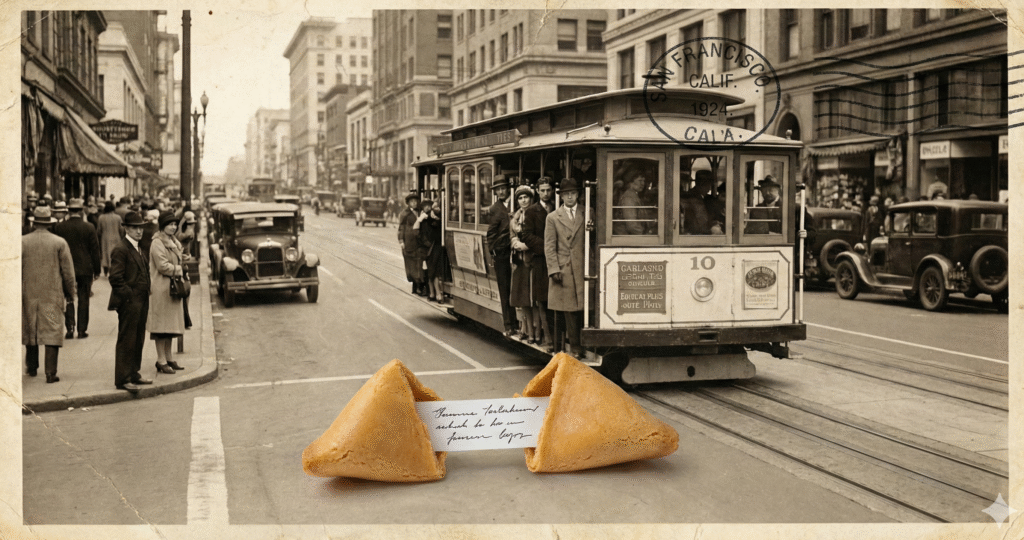
Down in Los Angeles, David Jung, founder of the Hong Kong Noodle Company, claimed he invented the cookie in 1918. His version of the story is a bit more altruistic: he supposedly passed out cookies stuffed with Bible scripture to the unemployed men gathering on the streets.
The debate was so heated that it actually went to a pseudo-court in San Francisco in 1983, which ruled in favor of Hagiwara and San Francisco as the rightful birthplace.
The Great American Shift
So how did a Japanese-American invention become synonymous with Chinese takeout? World War II. When Japanese Americans were tragically interned during the war, many Japanese-owned bakeries closed down. Chinese entrepreneurs, seeing a gap in the market and an opportunity, bought the equipment and began producing the cookies for their own burgeoning restaurant industry.
The rest is crunchy history.
Does knowing that your « ancient prophecy » is actually a Californian invention make it any less magical? We here at Cookie Prophecy don’t think so. Whether it comes from a mountaintop monastery or a factory in Brooklyn, when the universe wants to send you a message, it will find a way.
Even if that message is just confirming you really, really enjoyed those noodles.